
February 20
I have been exploring the possibilities of ‘AI’. Not to ‘mine’ data or ask questions on the Chat GPT website. But more so to find out what it can do for me when I am post-processing my photographs. Remember: my very first career was as a photo-journalist and I have been married to my camera ever since. I don’t use it as much as in yonder years, but it remains my faithful companion on trips and outings. And I am always interested new techniques.
Ever since cameras went from analog to digital, photographing with film has become the exception. There will always be nostalgic groups that do it, but it has become a costly business, what with the prices of buying film and the tools for processing the images in a dark room.
The first generation digital cameras were very disappointing, especially their atrocious performance in low light and with subjects at high speed. In 2004 I bought a horse, and unless I brought out my big analog SLR camera, I was not able to capture her speed. Even the first digital SLR was very limited. I love to do scenes in low light, and the digital SLR simply did not deliver. Some brands were better than others, but in general I regretted my investment. No wonder, really, because image quality (sharpness, ability to capture speed and low light) were worlds apart: First-generation digital cameras had 1–3 megapixel sensors as opposed to the equivalent of 8-15 megapixels in analog high-quality 35mm film. Film resolution also was not fixed, things like grain and contrast could theoretically deliver more detail than a fixed pixel count allowed.
But in recent years, digital photography has taken a gigantic leap and we now are blessed with high quality mirrorless cameras. The first generation digital SLR’s still had mirrors in them, like their analog brethren. The mirrors enabled photographers to look through the lens opening via reflection of the light hitting the lens opening. It made cameras extremely heavy, but the through-the-lens or TTL technique made photography a lot better at the time. These days, though, it is the computer inside the camera that projects the image the lens ‘sees’ and immediately processes any changes in settings as well. So it is no longer necessary to look at the back display of the camera to see how the shot came out. It is visible through the viewfinder. What a huge step forward!
Despite all the technology, it remains necessary to do at least post-processing. Both for sharpness and for light- and colour-adjustments. Apps like Photoshop have become increasingly good at post-processing and they have automated many of the things we used to have to do manually. Such as what? The removal of spots and distracting objects, compensating for light circumstances and combining multiple shots into one image.
I don’t mind doing post processing and I have already automated a lot of the default ones, so that they can run on a large series of shots taken during the same shoot.
But now we have ‘AI’. People no longer have to rely on photo-nutters like me to actually create artsy images that cannot be taken in-camera. AI helps us be more artistic.
The other day I was introduced to a web app named ‘Photobacks AI Studio’ and I have to admit that I am impressed. I want to share a particular journey with one of my photographs with you to share how ‘AI’ applies. It supports my opinion that ‘AI’ is incredibly helpful, but will never be able to completely take over from human input. And as such is not something to be afraid of or negative about. It is a fascinating new technique that is worth exploring.
The photograph I will be using is this one:

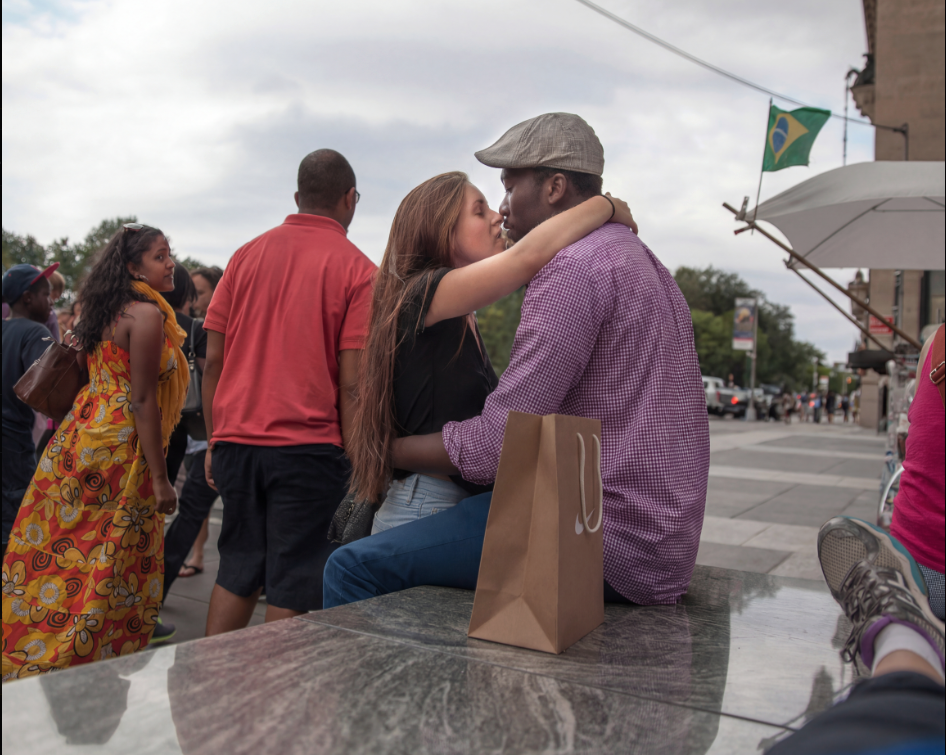
The title of this picture is ‘New York Kiss’. The above is the in-camera original.
Here is the story that goes with it.
Many years ago, my husband and I took his daughters to visit New York. We lived near Philadelphia at the time, so the trip to the big apple was a fairly quick one. After walking around in the city for hours on end, my husband and his daughters wanted to visit the Apple Store, which is quite close to Central Park. I was quite exhausted and in pain because I used to suffer from an auto-immune condition that caused significant joint and muscle pain (which has cleared up a lot, I am happy to report!). So I let everybody do their Apple-Store thing and decided to stretch out on a little wall next to the sidewalk myself. My body needed a rest! Of course I had my camera with me during this trip and I was playing around with it when a lovely couple came into the viewfinder.
Right at my feet (in the right part of the original picture) they collapsed into an intimate embrace and started kissing passionately, in the middle of the hustle and bustle of pedestrians and oblivious of their surroundings. Romance was in the air!
If there is one city on earth that lovers gravitate to it is of course New York. I am not a peeping Tom and a kissing couple is not something I tend to photograph. But what made this scene different was the young Asian lady in the orange dress. When she entered the scene I was instantly interested. She was the only passer-by who seemed to notice the couple and she shot them a direct look. I cannot fathom what she was thinking. Was she secretly yearning for a romantic embrace herself? Did she disapprove of all this passion displayed for all to see? Did she wish that SHE was in the arms of the boy? Who knows! To me, she was the center of the story in this photograph.
The thing that always bugged me though, was how busy the scene was. I could retouch it in post processing, but I could not take out all of the other pedestrians in a realistic way. So I cropped my feet out of the picture and that was it.
Be aware of online content
Before I get into working with AI, let me tell you a couple of things you may not be aware of. First of all, whatever you upload into an online AI app is no longer yours. You give it away. How so? No matter what apps tell you, you can be sure that your picture remains somewhere on a server-location you no longer have control over. For my particular photograph that is not something I worry about, because it has been published multiple times already. On my website, in shows, in exhibitions, etc. But my warning to you is to always be aware of what you upload. Read the fine print of where your picture is going to land and if it will be deleted after you are done. I would still not believe that promise.
If you doubt my words, read about the role of ‘Open AI’, the company that runs the Chat GPT website, in the recent terrible Alberta (CA) shooting. The shooter’s Chat GPT account was flagged and banned in June 2025 due to troubling posts involving gun violence. The ban did not lead to reporting these posts to the authorities, unfortunately. What I am trying to say is: secrets are not safe in the online world. So… be aware and protect your privacy, avoid uploading sensitive or personally identifiable images, never mind any platform’s published data policy.
‘Photobacks AI Studio’
For your information: ‘Photobacks AI Studio’ does not explicitly state that it retains pictures, but it does not state the opposite either. Oftentimes uploaded materials are temporarily used to train ‘AI’ Models. If you want to know what an AI Model is, read the blurb in the bottom of this page. It may be a bit technical, but if you are looking for the facts as I understand them: they are there.
‘Photobacks AI Studio’ much like most of the generally accessible ‘AI’ models lets you give it a command in normal human language. The more precise you can be, the better the results.
So, in my first round I told it to get rid of people in the background, to the right of loverboy. This produced a good result. The man was gone. And so was the vendor cart that was there in the original shot. But that did not bother me. However, the man’s reflection still remained in the smooth surface of the wall I was lying on. Since I am a stickler for detail, I decided to get rid of that myself, since I am well-versed in Photoshop. Next I wanted to get rid of the person visible where we can see in between the faces of the lovers. That shoulder and white shirt. In first instance, the result looked good. But when I looked closer, I noticed that now the profiles of the couple had changed. I had not asked for that. But it is very typical of ‘AI’ generated changed: every time you ask a question, the results will be different… So you have to pay close atttention during every round of edits. I corrected this mishap manually in Photoshop. Below is the result of where this got me. Not bad!
Then I wanted to get rid of the man in the red shirt. That was easy and quick.
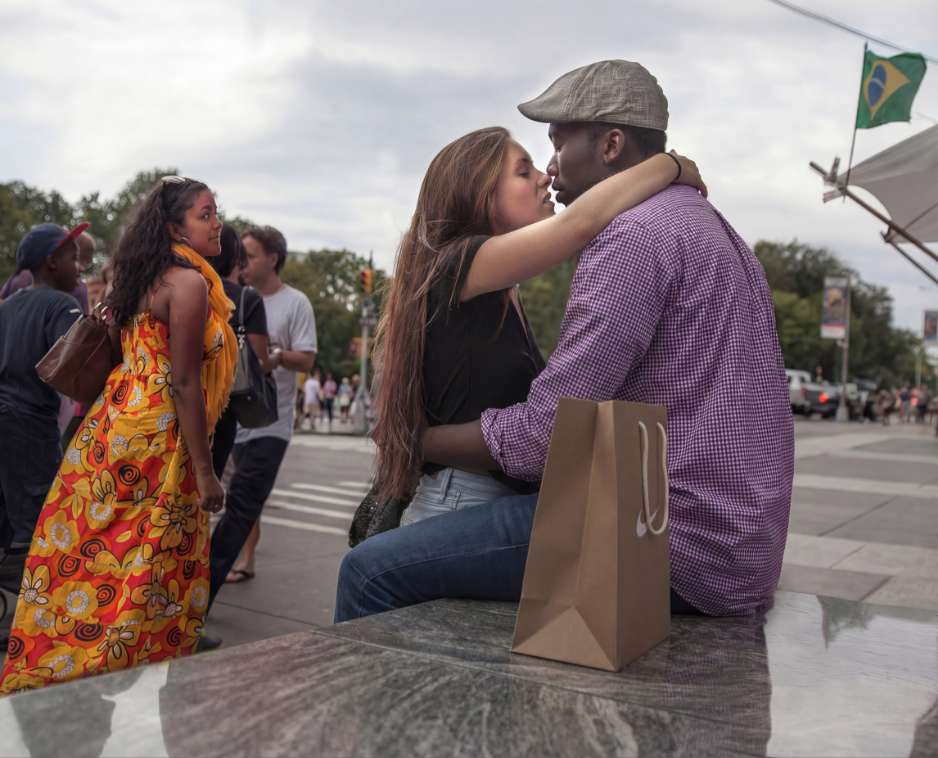
But something happened in that editing-round that is quite typical for ‘AI’. To the right of the lady in the orange shirt, one blue jeans-clad leg of the person in the background is missing! Granted, the leg was never there in the original photograph, but hey, I thought ‘AI’ would fix that! It could not and it was hard to do manually. The only choice now was to get rid of that person as well. I asked and I received.
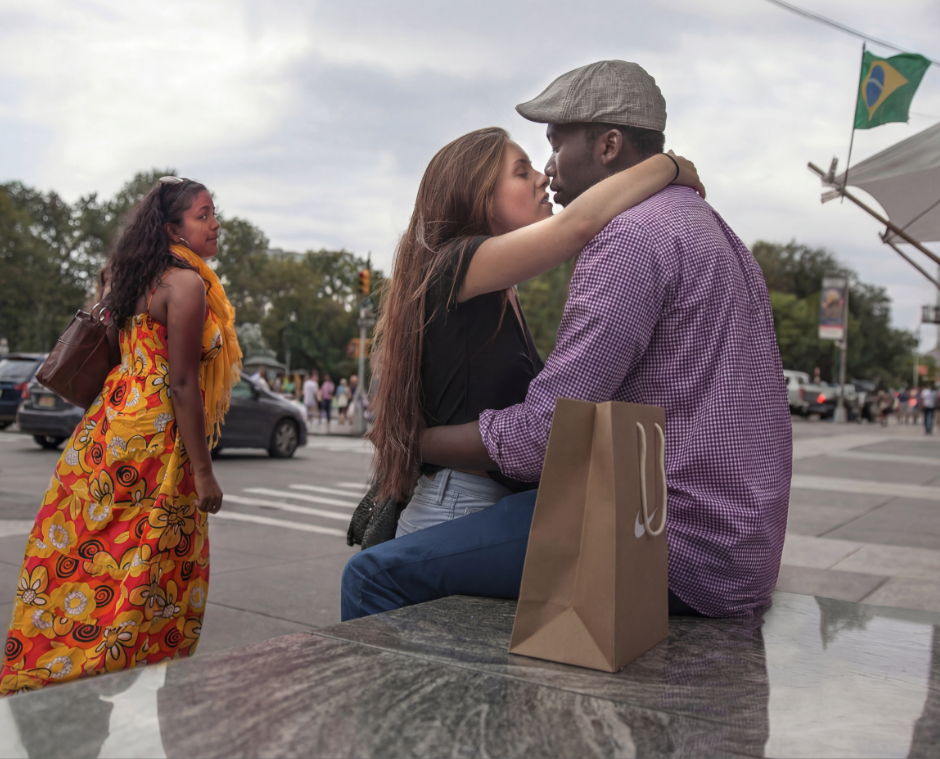
You will notice that I now got a car in the background instead. But, considering this shot was taken at a busy intersection, that was acceptable. ‘AI’ also made a good guess of other objects in the background surrounding the lady in the orange dress. Whether there actually is a pedestrian crossing in that spot and whether the placement of the car makes sense is doubtful. But the final shot after multiple iterations in an ‘AI’ app is certainly cleaned-up.
The question now begs: which do you like better?
Do you like that the kissing couple is isolated and that more attention now goes to the look they are getting from the lady in orange?
Or do we actually miss that hustle and bustle that is so typical for big cities? And that communicates to us how oblivious the lovers are of everyone surrounding them?
Let me know what you think. You can use the ‘Contact me’ form on this website, or find me on Facebook and tell me what you think there.
And finally…
As a photographer, I always strive to get the complete picture in-camera, without any hocus pocus. The ongoing ‘AI’ features in professional software products such as Photoshop already help me tremendously when I need to make adjustments to remove small distractions that were impossible to keep out of the shot. There is nothing wrong with that, in my opinion. The picture is still an authentic original. It is no more or no less than regular automation of features that, in my humble opinion, are usually an improvement in an app.
It is when objects or people or animals are inserted in a natural way, without being honest about it, that I start to become critical of the photographer who is claiming that a shot was taken in-camera.
In my 15 years as a photo-journalist, I worked with good cameras, lenses and film. But photographing news events needs you to be super quick. And sometimes you do miss some distracting object or person in the background. We had an excellent darkroom for developing our materials at the newspaper. And it was absolutely no exception to have to use objects and even our fingers, to block those distractions out of the picture. That handiwork is now offered as a standard feature in the digital world. We can get rid of little smudges easily. No problem at all.
Projects that require more adjustments for whatever reason should really be labeled as such. Whether it is through ‘Photoshop or AI’ or another app: I always hope that the photographer has enough pride in their work to be honest about such things. All Adobe Stock images are clearly marked when they are ‘AI’ Generated. And that is fair. Is such a photograph still a true original? When it comes to the nitty gritty of it, probably not, as ‘AI’ uses existing and made-up materials to come up with a ‘new’ image. It can also learn from existing images and blend multiples together if needed. But the creative spark is missing. Often you can recognise an ‘AI’ image because of its smooth perfection. Or an imperfection that would not escape the human eye. Such as that solo jeans leg in my picture.
Hallucinating
Did you know ‘AI’ can hallucinate? It is a word referring to very specific ‘AI’ behaviour. When ‘AI’ cannot find an answer to a question, or cannot solve an issue, it will make up an answer and posit it to you so convincingly that you will be tempted to believe it… but it is in fact a lie! In my photography, both the cars that were inserted and the pedestrian crossing details were invented by ‘AI’ and I bet the real intersection looks different. For the purpose of my image this does not matter though.
Conclusion
Technology makes it very easy to fool audiences. They see a manipulated photograph and fall for it. Let’s take it as a joke. And there IS some creativity involved in it as well. But also, whenever you get the feeling that a scene cannot possibly be real, be on the lookout for artifacts that should not be there. Missing limbs. Streets that end suddenly. Objects with faded outlines. Differences in focus that make no sense. They can all be proof of bad ‘AI’.
For the most part, though, I welcome any ‘AI’ feature that can help me spend less time at the computer after coming back from a shoot, and getting ready to go out and photograph some more!
What is an ‘AI’ model?
An ‘AI’ model is a collection of code written by humans that can recognize patterns, make decisions, or generate new content. It can learn from processing data without direct, step-by-step human interference. Not exactly machine learning, but give a model enough variety and quantity of data to ‘train’ with, and it can learn. ‘AI’ is not something that is brand new. ‘AI’ models already are the ‘brains’ driving procedures in fields such as healthcare, entertainment and finance. And of course they are widely used in robotics.
A model can also be written BY a model… without human involvement. And this where it becomes quite mind-boggling – and frankly, a bit frightening.
Which is why there always needs to be some sort of human interaction with the models, to make sure models are not going rogue and still do what they were developed to do.
Because this technology was invented by humans, it can of course be used for shady purposes. As such it is no different from anything else humans have their hands in, unfortunately. It is in our nature, it seems.
But, when used with wisdom and good morals, it can save us a lot of time and take out a lot of human errors, especially when interpreting large datasets.
It will also forever change many professional fields. Many companies will have to pivot significantly to adjust to what ‘AI’ can be for their products to prevent from having to close their doors. Education needs to be adjusted so we can all learn more about it.
‘AI’ tends to trigger strong emotions in people, but let’s try and keep an open mind and make sure we stay properly informed. It cannot be stopped and it does open new avenues in many fields.